Your Child's Brain is Rotting,
Here is How To Stop it.

You remember who they were.
Before.
The kid who asked a million questions. Who built things, invented games, dragged you outside to look at something they found. The kid who got bored and turned that boredom into something.
That child is still in there.
But right now, you can barely reach them.
You call their name and they don't hear you. You sit at the dinner table and they're somewhere else entirely. You watch them go to bed exhausted, brain buzzing from two hours of scrolling, and wake up the same, and you think:
"This can't be their childhood."
And then, because you love them, you try to fix it.
You set limits. You install apps. You take the phone away. You sit down and have the talk, the calm one, then the firm one, then the one where your voice cracks a little because you're scared.
And nothing sticks.
The limits become negotiations. The apps get bypassed. The conversation turns into a fight. The fight turns into a cold silence. And somewhere in the middle of all of it, you start to wonder if you're the problem.
You are not the problem.
But I need to tell you something that changes everything.
It's Not Your Child. It's Not You. It's the System.
Here is the thing no one tells you.
The reason your child can't put it down, the reason every rule you set gets eroded, the reason they transform into a different person when you try to take it away, it's not a discipline problem.
It's not your child's character.
And it's not your fault.
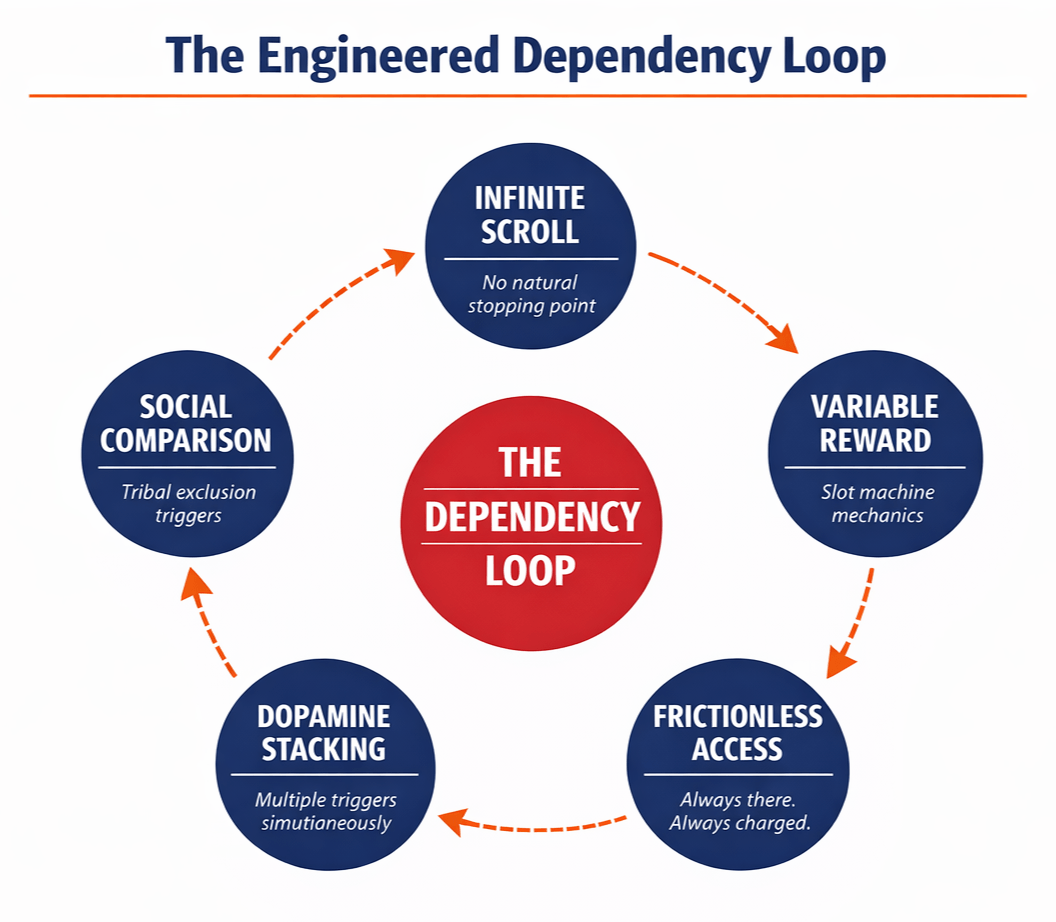
Your child is caught inside a system that was designed, by some of the most talented engineers on the planet, to be impossible to stop.
The apps your child uses are built by teams whose only job is to figure out how to make a developing brain stay inside the app longer. They study dopamine loops. They test reward schedules. They optimize every notification, every scroll mechanic, every autoplay algorithm to keep a young, still-forming brain hooked.
They are very good at their jobs.
You feel like you're competing with a billion-dollar algorithm for your child's attention.
You are.
So when you installed the parental control app, and your child cracked it inside a week, that wasn't defiance. That was a teenager doing what teenagers do when a $100 billion system has spent years sharpening their need for the thing you just blocked.
When you took the phone away and they raged, that wasn't a character flaw. That was withdrawal. Real, neurochemical withdrawal from a substance the body has learned to need.
And when the calm conversation fell apart the moment you brought it up, it wasn't because you said the wrong words.
It's because you were trying to solve an environmental problem with a behavioral tool.
That's the thing about a flood. A screwdriver doesn't help.
And there's something else you need to know. Something about what's happening inside your child's brain right now, while you're reading this.
Every Month You Wait, the Window Gets Smaller...
I want to be honest with you, because I think you already sense this.
Every hour your child spends inside that loop is an hour their brain is not doing what it was built to do.
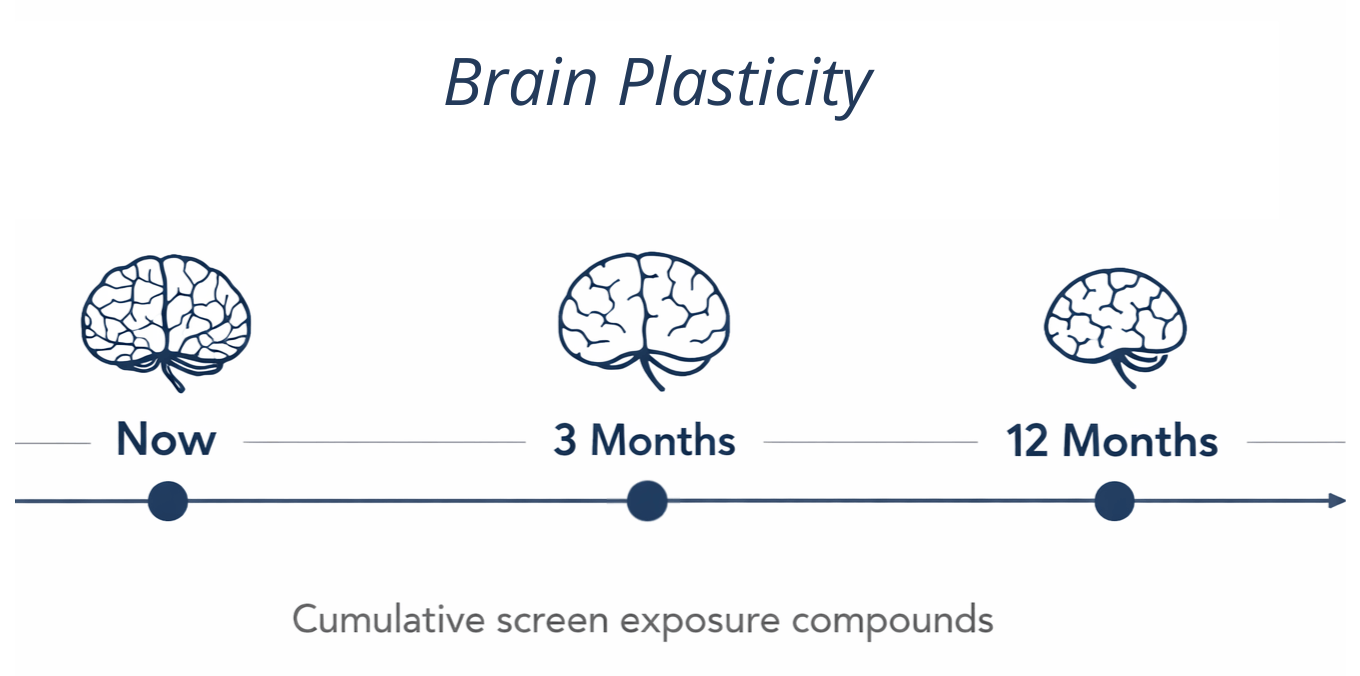
The brain of a child and a teenager is not a finished product. It is still forming. Attention circuits, emotional regulation, creative capacity, the ability to tolerate boredom and turn it into something, these are not set in stone. They are being built, right now, through the experiences your child is having.
When a screen delivers an endless stream of high-stimulation, low-effort reward, the brain adjusts. It recalibrates what "interesting" means. It loses tolerance for slower, harder things like reading, conversation, sustained creative work.
The curiosity that used to drive your child to explore and build and imagine, it doesn't disappear. But it gets quieter. And every month it sits quiet, it gets harder to wake back up.
"She used to be so curious. That curiosity is gone."
I hear this from parents everywhere. The curiosity isn't gone. But the environment your child is living in is drowning it out.
Here is the part that matters most.
The developmental window is still open.
It is not infinite. It is not permanent. The brain remains plastic through adolescence, but the plasticity is greatest now, not in five years.
The question is not whether to act. The question is when.
"If I don't intervene now, who will?"
You've Been Fighting the Eating. Nobody Told You to Move the Bowl.
Think about it this way.
Imagine you put a bowl of candy on the kitchen counter. Every day, refilled, always there. And then, every day, you punished your child for eating it.
Would you blame them?
Or would you move the bowl?

Every approach you've tried, the apps, the rules, the conversations, the confiscations, has been about the eating. None of it has been about the bowl.
The bowl is the environment your child lives in.
The phone charger next to the bed. The automatic Wi-Fi. The bedroom with no friction between a bored brain and infinite stimulation. The household pattern where screens are the default for transition time, for winding down, for every moment of low-stimulation.
These environmental conditions produce screen dependency the same way leaving the candy on the counter produces candy consumption.
Change the environment, and the behavior follows.
Not through confrontation. Not through willpower. Not because your child suddenly decided to cooperate.
Because the path of least resistance changed.
This is the insight that behavioral scientists call The Attention Rebuild Protocol. And it is why parents who use it see results that years of behavioral approaches never produced.
I want to show you exactly what that looks like for a real family. Because until you see it, it's easy to assume your situation is different.
Claire Had Tried Everything. Then She Was Asked the Question No One Had Asked Her...
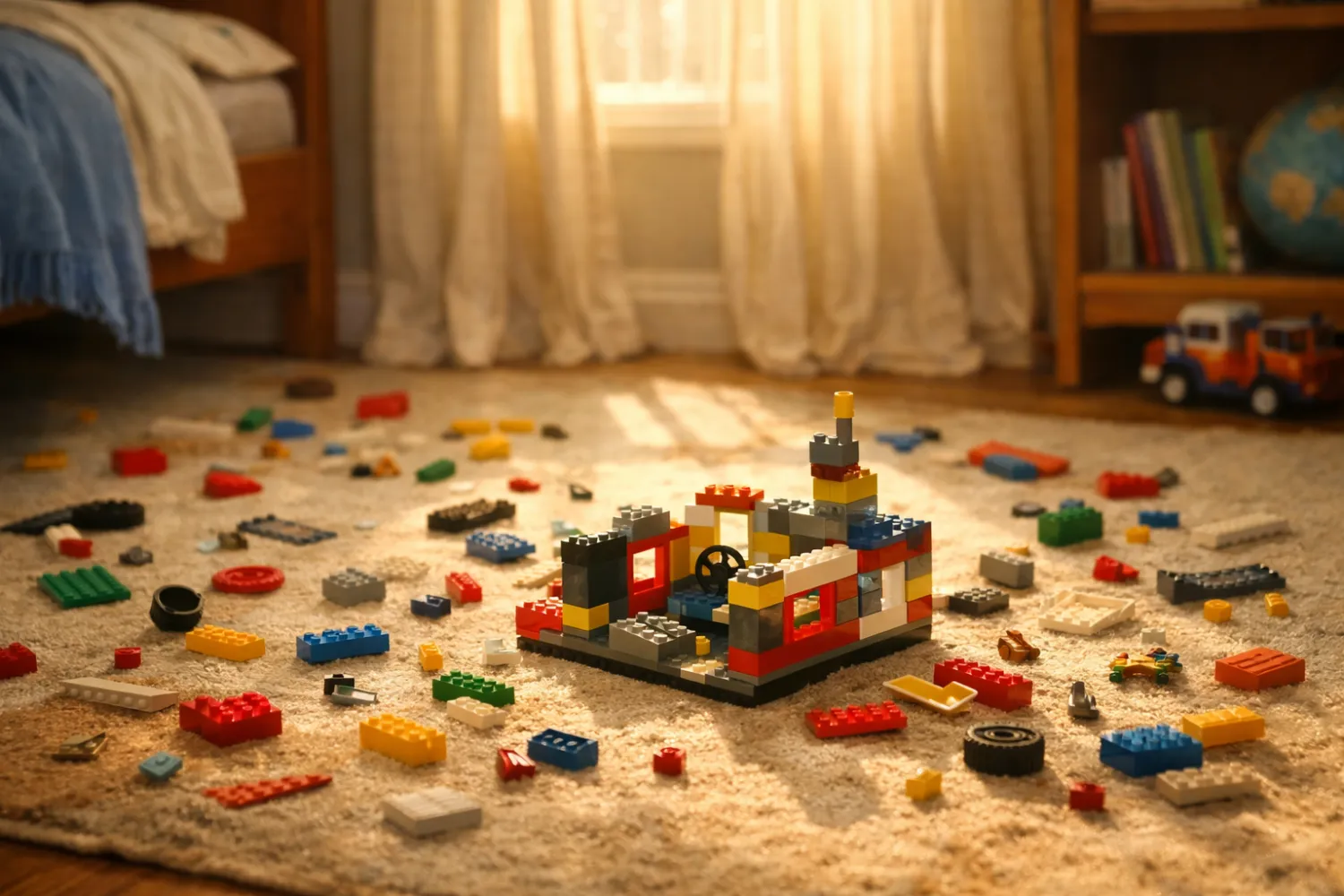
Her son was 11. Bright kid. Used to love Lego, used to spend entire Saturday afternoons building complicated things. By the time Claire came to me, that was gone. He'd come home from school, go straight to his room, and stay there until dinner. Sometimes past dinner.
His teacher had flagged that he was having trouble concentrating. His grades weren't collapsing yet, but they were slipping. And something in his eyes had changed. Claire described it as a kind of flatness.
She'd tried everything. The apps, the timer on the router, the Friday-to-Sunday ban that lasted two weeks before the household tension became unbearable. She'd read three books and watched dozens of videos. She'd had the calm conversation and the firm conversation and a very tearful conversation that neither of them wanted to have.
Nothing worked. Or rather, nothing stuck.
When I asked her to describe her son's environment, what his bedroom looked like, where the charger was, what happened in the 15 minutes after he got home from school, I noticed something.
Every single low-friction moment in his day led directly to a screen.
Not because he was weak. Not because she had failed. Because the environment had been quietly, invisibly organized around screens without either of them noticing.
We changed the environment. Not dramatically. Not all at once. Gradually, in sequence, in the specific order that produces results without triggering resistance.
In 21 days, Claire told me she had her son back.
He'd started building again. Not Lego, but something different. He was reading at night instead of scrolling. He came to dinner and actually talked.
"I didn't do anything special. I just changed what was around him."
ClaireThat is exactly right.
But here's what Claire didn't know going in. The order in which we made those changes was not random. And that sequence is the only reason it didn't turn into a fight.
Most Parents Change the Right Things in the Wrong Order. That's Why It Turns Into a Fight...
Here is something most parents miss.
Environmental changes introduced in the wrong order create the exact resistance you're trying to avoid.
There's a reason Day 3 comes before Day 7. There's a reason the bedroom changes happen before the common space changes. There's a reason specific transitions get addressed in a specific week.
The sequence is not arbitrary. It's built around how a child's brain processes change, and how to keep those changes below the threshold of resistance.
When you move the charging station before you've established the alternative landing zone for transition time, you get a fight.
When you do it in the right order, with the right words, your child barely notices.
And because they barely notice, the change holds.
That's the difference between this and everything you've tried before. Not the individual changes. The architecture.
So I wrote it all down. Every change, in the right order, with the exact words to use. And I turned it into a system any parent can follow, starting today...
So I Built the Exact System I Wish Claire Had Found on Day One.
The Attention Rebuild Protocol for Parents Who Are Done Fighting the Behavior and Ready to Change the Environment.
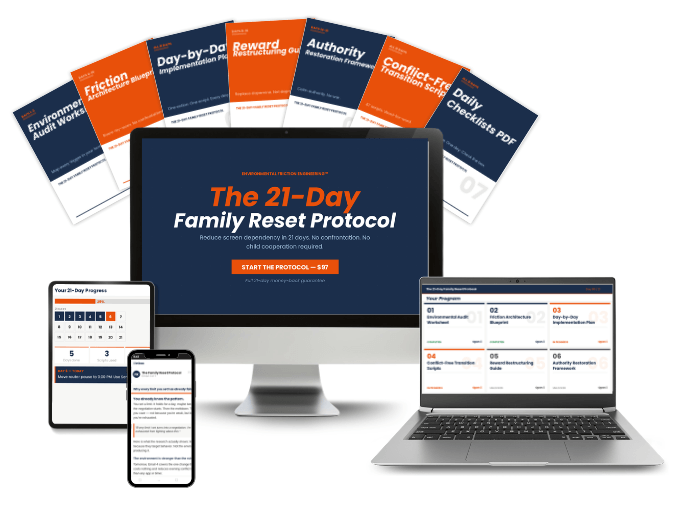
This is a structured 21-day digital program that gives you a complete, day-by-day plan for redesigning your home environment to reduce your child's screen dependency, without confrontation, without your child's cooperation, and without willpower that has to be sustained indefinitely.
This is not another parenting course. There is no philosophy to absorb, no mindset shift required, no lengthy video modules to work through before you can do anything.
Every day has one specific action. A script. A checklist. A fallback plan for if your child pushes back.
The structure does the thinking. You do the doing.
Here is exactly what you get:
21 days of specific actions, sequenced in the order that produces the most change with the least resistance.
No guessing. No figuring out what to try next.
Open Day 1. Do Day 1. Then Day 2.

Before you change anything, you need to see clearly what you're working with.
This guided diagnostic maps your home's specific screen triggers, access points, and reward loops.
You'll know exactly what to change and in what order before you start.

Word-for-word language for every change you'll introduce.
What to say. What not to say.
How to respond when your child pushes back, because some of them will, and you need the exact words ready before that moment arrives.

The specific environmental modifications that reduce screen pull without removal.
Organized by room, routine, and time of day.
Not generic advice. Specific changes with specific instructions.
Your child's brain is getting something from screens. Something real.
Dopamine, stimulation, connection, escape.
Until those needs have somewhere else to go, the pull doesn't ease.
This guide shows you how to build genuine alternatives that actually satisfy those needs.

How to consolidate the changes you've made so the outcomes become the new baseline.
Rebuilt attention. Restored creativity. Better sleep. Stronger social skills.
These don't have to disappear after 21 days. This framework is how they stay.

A daily checklist for each of the 21 days.
Nothing to remember. Nothing to figure out.
Every action is already broken down.
You open it, you follow it, you check the box.

What They Say, Once They Get Their Child Back.
"He started reading again. Not because I asked him to. Just because he was bored and the book was there."
"I have my daughter back. That's the only way I can describe it."
"The fights stopped. Not because I became stricter. Because the thing we were fighting about stopped being everywhere."
"I almost didn't buy this. But $27 versus what I'd already spent on apps, books, and one very expensive family therapist who told me to 'set clear limits'... it wasn't even a question."
"She came and sat with me in the kitchen while I was cooking. Just to talk. I can't remember the last time that happened."
I Know What You're Thinking. I've Heard It Before.
Let me answer the questions you're already asking.
"This won't work on my child. He's too stubborn."
The protocol doesn't require your child's cooperation. It doesn't depend on their willingness or their agreement. It changes the environment they're living in. The environment does the work.
"My teen will just find another way."
There is nothing to hack. No app to bypass. No code to crack. The changes are physical and structural. You are not building a wall. You are changing the landscape so the wall becomes unnecessary.
"We've tried everything."
You've tried everything behavioral. Rules, punishments, negotiations, apps. You have not tried changing the environment that's producing the behavior. That is a different mechanism entirely. The fact that behavioral approaches haven't worked is not evidence that nothing will. It's evidence that behavior was the wrong target.
"I don't have time for a 21-day program."
Each daily action takes minutes, not hours. You are not committing to a daily practice. You are making a change. Then the environment holds that change for you while you do something else.
"My child needs their phone for school."
The protocol does not remove the phone. It restructures the environment around it. There is a significant difference between a child who uses a phone for school and a child whose brain has been rewired to need the phone as a constant source of stimulation. The protocol addresses the second without interfering with the first.
"It'll just turn into a fight."
Every change in the protocol comes with a word-for-word script and a fallback plan for exactly that scenario. You will not be improvising in a heated moment. You will have the words ready before you need them.
"My child has ADHD. It's different for them."
It works for them too. ADHD brains are more sensitive to environmental cues, not less. That means when the environment changes, the response is often faster and more visible than with neurotypical kids. The protocol doesn't fight your child's brain. It works with how that brain actually responds to what surrounds it.
"What if my ex doesn't do the same things at their house?"
One environment is enough to shift the baseline. You control your home. The changes you make here matter, regardless of what happens elsewhere.
At this point, the only real question is timing.
Do you start while the window is still open... or do you wait and hope it gets easier?
One More Thing. I Only Take 50 Families a Month. Here's Why.
I am not running this as a volume operation.
Every month, I open 50 spots. That is it. When those spots are filled, the page closes and the next cohort begins next month.
Every family that joins gets a real response from me. Not a bot. Not a template. Every question answered. Every parent heard.
That kind of attention has a limit. And that limit is 50 families a month.
If you are reading this and the page is still open, there are still spots available. I can't tell you how many. I can tell you that this month's cohort will close, and the parent who decides to wait will start one month later.
One month of your child's development. Compounded.
The Brain You're Trying to Protect Is Developing Right Now.
Here is the thing I keep coming back to.
The parent who acts today is not solving a current inconvenience. They are protecting a future.
The attention your child can rebuild in the next 21 days is the attention they will carry into high school, into their academic performance, into their capacity to sustain focus on hard things.
The creativity you protect now is the creativity that makes them interesting, adaptive, capable adults.
The anxiety and depression risk that correlates with heavy adolescent screen use, this is documented by the CDC. And it is dose-dependent. Every month of compounded exposure adds to that risk.
You already know this. That's why you're here.
The question is not whether this matters. The question is whether you act now, while the window is open, or whether you wait for a moment that feels more convenient, that never quite arrives.
"I'm scared I waited too long."
You haven't. But the window does not stay open forever.
Every hour your child spends in that loop is an hour their brain is not doing what it was built to do. The window is still open. Right now.
The 21-Day Family Reset Protocol
How to use simple environmental changes to break your child's screen dependency, restore their focus and creativity, and give them back the future that's quietly being taken from them, one scroll at a time.
- The complete Day-by-Day Implementation Plan (21 days, fully sequenced)
- The Environmental Audit Worksheet
- The Conflict-Free Transition Scripts
- The Friction Architecture Blueprint
- The Reward Restructuring Guide
- The Future Protection Framework
- Checklists for every phase
Total value: everything your child's developmental trajectory is worth to you.
$27
Instant access · 21-day money-back guarantee
PROTECT MY CHILD'S DEVELOPMENT — START THE 21-DAY RESET50 spots per month. This month's cohort closes when they're filled.

I guarantee that within 21 days, your child's screen dependency will measurably decrease, and you will start to get them back. Not as a quieter version of themselves. Not as a kid who simply lost access to something they still desperately want. As a child who is more present, more curious, more reachable. The child you remember.
But if you go through the protocol and don't see that change, just send me an email and I'll refund every cent, no questions, no hard feelings.
And even then, keep the entire program. The scripts, the blueprints, the checklists. All of it stays with you. Because your child's developmental window doesn't close the moment the 21 days end, and I want you to have everything you need when you're ready to use it.
Picture a Tuesday Afternoon, Six Weeks From Now.

I want you to imagine something.
It's a Tuesday afternoon, six weeks from now.
Your child comes home from school. They put their bag down. They wander into the kitchen.
And they talk to you.
Not because you asked. Not because the phone is somewhere else. Just because they're home, and they're present, and you're there, and that's still something that matters to them.
That moment is not a fantasy. It is what happens when the environment changes.
It is what parents in the protocol describe, again and again, as the moment they knew it had worked.
Not the metrics. Not the reduced screen time. The Tuesday afternoon when their child just came and talked to them.
That is what $27 buys.
That is what 21 days of environmental change can give back.
The window is open right now.
Questions? Email hello@attentionreset.co
The 21-Day Family Reset Protocol is a digital program. You will receive immediate access to all materials after purchase. Results vary based on implementation. The guarantee covers parents who complete the protocol and do not see measurable change. This site is not a part of Facebook or Meta Platforms, Inc.